6 min to read
Sprint 1 Development Note
Development Note for Project Prism
This is the first development note for AI LED controller. For now, I am the sole developer for this project, but starting from next week, we will have more team members for market research and frontend developments.
Let’s get started!
1. Simplified Architecture Overhaul
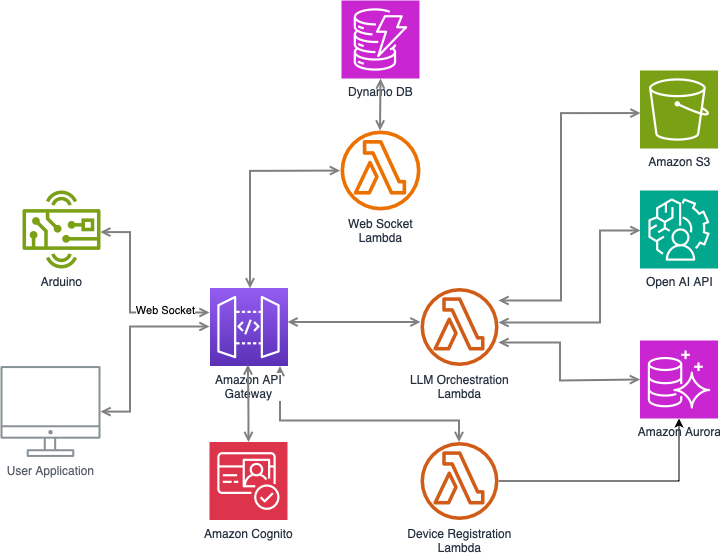 Original Project Architecture
The initial architecture was too complex for an MVP, resembling a production-level design. Given our development timeline, we simplified it.
Key Changes
Removed RDS
- Security Concerns: RDS must be placed in a private subnet, meaning that Lambda must also be in a private subnet to access it.
- Lambda Limitations: If Lambda is in a private subnet, it complicates API access (e.g., Gemini API) since internet access requires a NAT Gateway, adding both cost and complexity.
- Solution: Replaced RDS with DynamoDB:
- Utilizes Partition Key + Sort Key for structured storage.
- Direct AWS service network access (not bound to VPC).
- Fully managed → Lower operational overhead & easier maintenance.
- Simplified architecture for MVP.
Removed Login Feature (AWS Cognito)
- Authentication complexity is unnecessary in an MVP.
- Replaced with a simple mock login:
- Uses Device UUID + PIN for minimal security.
- Known security risks:
- Vulnerable to replay attacks & client-side exploits.
- Decision: Acceptable for MVP, security will be enhanced in future iterations.
Manual Device Registration
- Since authentication is removed, devices will be manually registered in the MVP.
- Given the limited number of users, manual configuration is feasible.
- Result: Lower complexity & faster development.
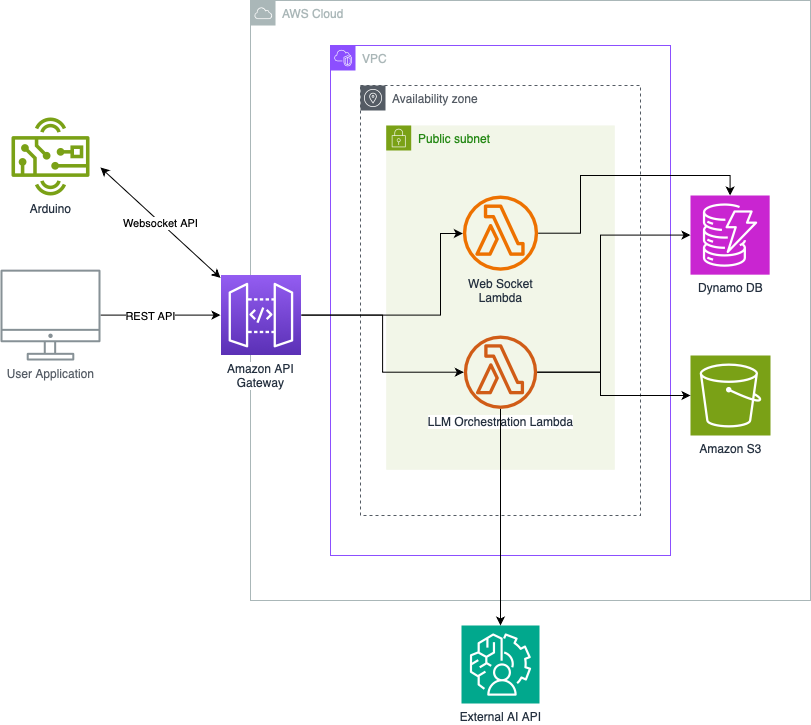 Changed Project Architecture
2. LLM Orchestration Lambda Development
Developed the LLM Orchestration Lambda, covering:
Authentication
- Queries the
auth tableto verify(uuid, pin).
Audio Processing via Gemini API
- Calls Gemini API for processing.
Success Handling from Gemini API
- Store JSON response in S3 (
user/{arduino_uuid}/...) with encryption. - If the response contains an RGB command:
- Query DynamoDB for preset colors.
- Find the closest RGB match.
- Compute RGB adjustments.
- Retrieve the
connection_idfrom websocket table usingarduino_uuid.
3. Gemini Prompt Engineering Completed
We finalized the Gemini AI Prompt & Structured Output.
🎯 AI Prompt
You are an AI assistant designed to analyze audio input and recommend light settings based on the user’s emotional state, context, and time, while utilizing light therapy principles.

**Instructions:**

1. **Analyze Audio**:
   - Detect emotional cues & context (e.g., studying, gaming, sadness).
   - Consider the time of day.

2. **Determine Light Settings**:
   - **Color**: RGB [R, G, B] (0–255) or a **dynamic mode** (FLASH, FADE, etc.).
   - **Brightness**: 0–7.

3. **Identify Emotions**:
   - **Main emotion**: Positive, Negative, Neutral.
   - **Three subcategories** (e.g., Happiness, Excitement, Anxiety).

4. **Apply Light Therapy**:
   - **Morning/Afternoon** → Use bright, cool-toned lights (white, blue).
   - **Evening/Night** → Use warm tones (amber, red) for relaxation.
   - **Negative emotions** → Use calming/uplifting light settings.
   - **Positive/Neutral emotions** → Reinforce the current state.

5. **Recommendation**:
   - If **negative**, suggest a setting to **improve mood**.
   - If **positive/neutral**, reinforce their current state.
   - **Provide a concise explanation** of the choice.

6. **Context Consideration**:
   - Summarize the user’s situation.
   - If unclear, use a **random preset**.
🎯 Structured Output
{
  "type": "object",
  "properties": {
    "lightSetting": {
      "type": "object",
      "properties": {
        "color": {
          "type": "string"
        },
        "brightness": {
          "type": "integer"
        },
        "power": {
          "type": "boolean"
        }
      },
      "required": ["color", "brightness"]
    },
    "emotion": {
      "type": "object",
      "description": "Emotion Analysis",
      "properties": {
        "main": {
          "type": "string",
          "enum": ["Positive", "Negative", "Neutral"]
        },
        "subcategories": {
          "type": "array",
          "items": {
            "type": "string",
            "enum": [
              "Happiness",
              "Excitement",
              "Gratitude",
              "Euphoria",
              "Pride",
              "Calmness",
              "Satisfaction",
              "Contentment",
              "Serenity",
              "Relief",
              "Astonishment",
              "Pleasant Surprise",
              "Disappointment",
              "Loss",
              "Loneliness",
              "Depression",
              "Regret",
              "Frustration",
              "Annoyance",
              "Rage",
              "Resentment",
              "Betrayal",
              "Anxiety",
              "Terror",
              "Concern",
              "Skepticism",
              "Helplessness",
              "Repulsion",
              "Aversion",
              "Unpleasantness",
              "Loathing",
              "Shock",
              "Unpleasant Surprise",
              "Detachment",
              "Objectivity",
              "Ambivalence",
              "Pragmatism",
              "Logic",
              "Clarity",
              "Balance",
              "Neutrality",
              "Steadiness"
            ]
          }
        }
      },
      "required": ["main", "subcategories"]
    },
    "recommendation": {
      "type": "string"
    },
    "context": {
      "type": "string"
    }
  },
  "required": ["lightSetting", "emotion", "recommendation", "context"]
}
4. Next Week’s Goals
Frontend
- Complete UI/UX design.
- Complete creating backend infrastructure with Terraform
- Complete CI/CD pipeline for Frontend repo
Backend
1️. Finalizing LLM orchestrator Lambda
- Complete full request-handling logic.
2. Backend Infrastructure Building
- Complete creating backend infrastructure with Terraform
- Complete CI/CD pipeline for Backend repo
Sprint 1 Summary
✔ Architecture Simplified (Removed RDS and Cognito, switched to manual device registration). ✔ Progress in LLM Orchestration Lambda (Auth, Audio Storage, API Processing, Response Handling). ✔ Gemini Prompt & Structured Output Finalized.
🚀 Next Steps We are going to finish developing the LLM Orchestration Lambda, start developing Arduino software to parse JSON from backend and send IR signal to LED strip.